
From Light Signals to Spacetime
Physics ·Take two long railcars moving along parallel tracks. Each railcar carries clocks fixed at several positions. We call each railcar together with its clocks a laboratory. Laboratory \(S\) calls its positions \(x\) and its clock readings \(t\). Laboratory \(S'\) uses \(x'\) and \(t'\).
Each clock remains at a fixed position \(x\) on \(S\). Likewise, each clock on \(S'\) remains at a fixed position \(x'\). This allows a local recording device to store the pair \((t,x)\) or \((t',x')\) as soon as an event occurs there, without waiting for information to travel to another part of the laboratory.
Attach a contact switch and memory to each clock. When a clock on \(S'\) passes a clock on \(S\), their switches touch at one point and trigger both memories. This local contact is event \(P\). The clock on \(S\) stores its reading \(t_P\) and its fixed position \(x_P\). The clock on \(S'\) stores \(t'_P\) and \(x'_P\). The pairs \((t_P,x_P)\) and \((t'_P,x'_P)\) are the event’s coordinates in the two laboratories.
We idealize the switches as pointlike and subtract their measured internal delays. The records are collected afterward; no signal must travel across either laboratory when \(P\) occurs.
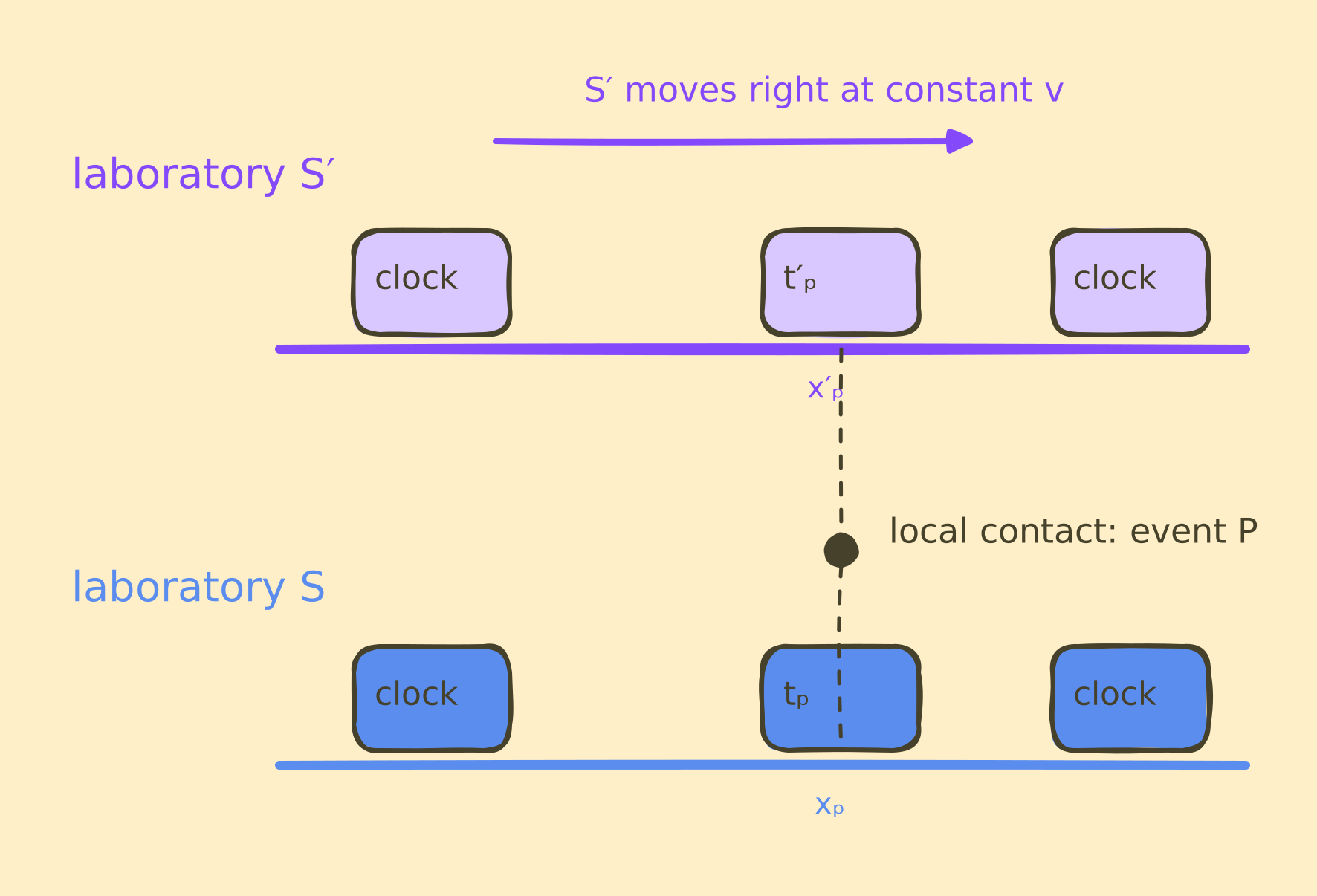
Focus on the center clock of \(S'\). Each time it contacts a clock on \(S\), that clock stores \(t\) and \(x\). Use these pairs to define \(x(t)\), the position of the center of \(S'\) at time \(t\) according to \(S\). The measurements fit
\[x(t)=x(0)+vt.\]This is uniform relative motion. In \(S\) coordinates, \(S\) has velocity zero and \(S'\) has the measured velocity \(v\). The value of \(v\) is an input to the experiment, not a universal constant.
We ask:
What rule relates the pairs \((t,x)\) and \((t',x')\) stored at the same local contact event?
1. How does one laboratory synchronize its clocks?
The clocks on one railcar need a rule for assigning common time labels. Its center clock emits one light pulse when it reads \(t_{\mathrm{emit}}\). A clock at position \(x\) reflects the pulse immediately, and the pulse returns to the center clock when it reads \(t_{\mathrm{return}}\). Define
\[\begin{aligned} t_{\mathrm{reflect}} &:=\frac{t_{\mathrm{emit}}+t_{\mathrm{return}}}{2},\\ c &:=\frac{2\lvert x\rvert}{t_{\mathrm{return}}-t_{\mathrm{emit}}}. \end{aligned}\]The first line synchronizes the remote clock: the remote clock is adjusted to read \(t_{\mathrm{reflect}}\) when it reflects the pulse. In the second, \(c\) is the measured round-trip speed of light.
The synchronization convention makes the one-way coordinate speed of light equal to \(c\). Its empirical input is that repeated round-trip measurements give the same value \(c\) regardless of the direction of the apparatus or the motion of the source. The convention alone cannot force different laboratories to obtain the same round-trip result.
2. Which laboratories provide the simple comparison?
Release several small test carts inside one laboratory after shielding them as well as possible from springs, air resistance, electric fields, and other detectable interactions. Attach a contact switch to each test cart and use its local encounters with the laboratory’s clocks to measure its position function \(x(t)\). The observations may fit
\[x(t)=x(0)+ut,\]where the constant
\[u:=\frac{dx}{dt}\]is the test cart’s measured velocity relative to the laboratory. A position function \(x(t)\) of this form is called a uniform trajectory.
A synchronized clock-and-position system in which sufficiently isolated carts obey this constant-velocity rule is called an inertial reference system. “Inertial” is not another word for stationary. Two such systems may move uniformly relative to one another.
This definition is operational but approximate. A laboratory is treated as inertial only over the region and duration in which free test carts show no detectable departure from the rule.
For the experiment in the opening, require both clock-and-position systems to be inertial. Arrange their center-clock switches to make local contact at
\[t=t'=0, \qquad x=x'=0.\]The origin choice sets \(x(0)=0\). The measured rule from the opening therefore becomes
\[x(t)=vt.\]No new motion assumption has been added here; the origin choice only removes the constant \(x(0)\).
3. Why does this first rule fail for light?
The origin of \(S'\) has position function \(x(t)=vt\) according to \(S\). Now consider any event to which \(S\) assigns coordinates \((t,x)\). Subtracting the origin’s position \(vt\) from the event’s position \(x\) gives the first proposed spatial rule. This does not determine the time assigned by \(S'\). As a separate first hypothesis, suppose both laboratories assign the same time to every event. Consequently, if two events are simultaneous in \(S\), they are also simultaneous in \(S'\): \(\Delta t=0\) implies \(\Delta t'=0\).
\[x'=x-vt, \qquad t'=t.\]For an event on the moving origin, its position coordinate is \(x=x(t)=vt\). Substitution gives
\[x'=vt-vt=0.\]At the center-clock contact event, the local trigger also makes a lamp fixed to \(S\) emit a light pulse toward increasing \(x\). Both laboratories assign the emission \((t,x)=(0,0)\) and \((t',x')=(0,0)\). Laboratory \(S\) assigns each later event on the pulse’s path coordinates satisfying
\[x=ct.\]This rule predicts
\[x'=ct-vt=(c-v)t'.\]Thus it predicts the light speed \(c-v\) in \(S'\). A pulse traveling in the opposite direction similarly acquires speed magnitude \(c+v\).
But round-trip light measurements performed inside uniformly moving laboratories do not reveal such a dependence on the laboratory’s speed. With the synchronization rule from Section 1, each laboratory represents its light rays by
\[x=\pm ct\]or, in its own coordinates,
\[x'=\pm ct'.\]This first rule cannot preserve both observations. We therefore ask:
What coordinate rule maps every uniform trajectory to a uniform trajectory (because both \(S\) and \(S'\) were defined as inertial laboratories) and maps both light rays \(x=ct\) and \(x=-ct\) to light rays of the same speed in \(S'\)?
4. Construct the coordinate rule
No position along the tracks and no clock reading is special. Repeating the experiment elsewhere or later must give the same coordinate rule. We therefore assume a linear rule, meaning that
\[\begin{aligned} x'&=ax+bt,\\ t'&=dx+et, \end{aligned}\]where \(a\), \(b\), \(d\), and \(e\) are constant during the experiment. They may depend on the measured relative velocity \(v\), but not on the event’s coordinates \(x\) and \(t\).
Every event at the center of \(S'\) has \(x=vt\) and \(x'=0\). Substituting these values into \(x'=ax+bt\) gives
\[0=a(vt)+bt=(av+b)t.\]This must hold for every \(t\), so \(b=-av\). The coordinate rule is now
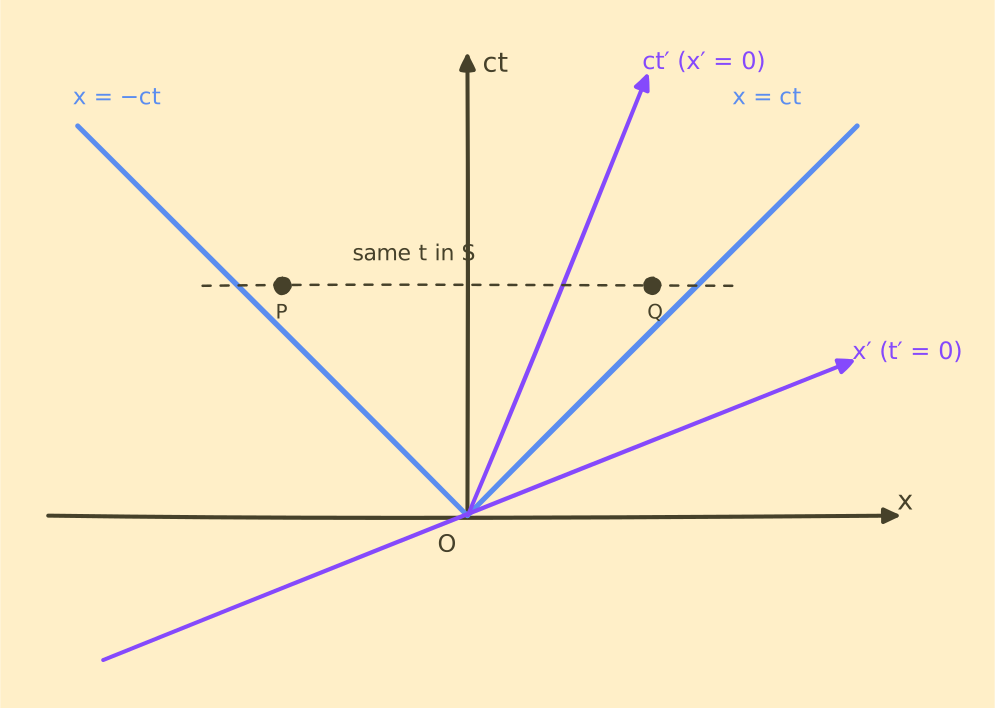
\[\begin{aligned} x'&=a(x-vt),\\ t'&=dx+et. \end{aligned}\]For the positive light ray \(x=ct\), the condition \(x'=ct'\) gives
\[a(c-v)=ce+c^2d.\]For the negative light ray \(x=-ct\), the condition \(x'=-ct'\) gives
\[a(c+v)=ce-c^2d.\]Adding these two equations yields
\[e=a.\]Subtracting the second equation from the first yields
\[d=-\frac{av}{c^2}.\]The rule must therefore have the form
\[\begin{aligned} x'&=a(x-vt),\\ t'&=a\left(t-\frac{vx}{c^2}\right). \end{aligned}\]It remains to determine the coefficient \(a\). Experiments performed entirely inside either inertial laboratory are assumed to obey the same physical rules. This assumption is called the principle of relativity. The labels \(S\) and \(S'\) and the choice of positive direction are arbitrary. Exchanging the labels leaves \(a\) unchanged and replaces \(v\) with \(-v\). Apply these replacements to the spatial rule:
\[x=a\bigl(x'-(-v)t'\bigr)=a(x'+vt').\]Substitute the expressions for \(x'\) and \(t'\):
\[\begin{aligned} x &=a\left[ a(x-vt) +va\left(t-\frac{vx}{c^2}\right) \right]\\ &=a^2\left(1-\frac{v^2}{c^2}\right)x\\ &\Longrightarrow a^2\left(1-\frac{v^2}{c^2}\right)=1. \end{aligned}\]Choose the positive root so that the rule approaches the identity when \(v=0\). Thus \(a=\gamma(v)\), where
\[\gamma:(-c,c)\longrightarrow\mathbb R_{>0}, \qquad \gamma(v):=\frac{1}{\sqrt{1-v^2/c^2}}.\]This real factor is defined for \(\lvert v\rvert<c\). The resulting rule therefore treats \(c\) as a limiting relative speed for the inertial laboratories considered here.
For the chosen pair of laboratories, \(v\) is fixed, so \(\gamma(v)\) is constant across events. Write \(\gamma:=\gamma(v)\).
The required coordinate update is therefore
\[\boxed{ \begin{aligned} x'&=\gamma(x-vt),\\ t'&=\gamma\left(t-\frac{vx}{c^2}\right). \end{aligned}}\]This is the Lorentz transformation in one spatial direction.
To state its input and output explicitly, define the dimensionless relative speed
\[\beta:=\frac{v}{c}.\]Then the coordinate-pair transformation is the linear map
\[\Lambda_v^{(1+1)}:\mathbb R^2\longrightarrow\mathbb R^2,\]We use the ordered coordinates \((ct,x)\) so that both coordinates have units of length and every matrix entry is dimensionless. In these coordinates,
\[\begin{pmatrix} ct'\\ x' \end{pmatrix} = \underbrace{ \begin{pmatrix} \gamma&-\gamma\beta\\ -\gamma\beta&\gamma \end{pmatrix}}_{[\Lambda_v^{(1+1)}]} \begin{pmatrix} ct\\ x \end{pmatrix}.\]The matrix is a coordinate representation of the map; the two event-coordinate pairs are its input and output.
5. What does the rule predict for clocks?
Choose two local contact events in which the center clock of \(S'\) passes two different clocks on \(S\). The center clock is present at both events, so their position difference in \(S'\) is
\[\Delta x'=0.\]The inverse time transformation is
\[\Delta t =\gamma\left(\Delta t'+\frac{v\Delta x'}{c^2}\right).\]Substituting \(\Delta x'=0\) gives
\[\Delta t=\gamma\Delta t'.\]The one clock from \(S'\) supplies both readings used in \(\Delta t'\). Two different clocks from \(S\) supply the readings used in the larger interval \(\Delta t\). This prediction is called time dilation.
The reading accumulated by a clock along its own path is called its proper time, denoted \(\tau\). For this clock,
\[\Delta\tau=\Delta t',\]so
\[\Delta t=\gamma\Delta\tau.\]No clock is claimed to malfunction. The two quantities are produced by different measurement procedures: one clock accompanies both events, while a synchronized pair of clocks in the other laboratory records them at different positions.
6. What does the rule predict for simultaneous measurements?
Consider a rod at rest in \(S'\). Let its endpoint separation measured there be
\[L_0:=\Delta x'\]for two endpoint events with \(\Delta t'=0\). This is the rod’s rest length.
To measure the moving rod’s length in \(S\), record both endpoint positions at the same \(S\) time:
\[\Delta t=0.\]The spatial transformation then gives
\[L_0=\Delta x'=\gamma\Delta x.\]Therefore the length assigned by \(S\) is
\[L:=\Delta x=\frac{L_0}{\gamma}.\]This is length contraction along the direction of relative motion. It is a prediction about two simultaneous endpoint observations, not a claim that every observer selects the same pair of endpoint events.
Indeed, if two separated events are simultaneous in \(S\), then \(\Delta t=0\) and
\[\Delta t' =\gamma\left(\Delta t-\frac{v\Delta x}{c^2}\right) =-\gamma\frac{v\Delta x}{c^2}.\]Unless \(\Delta x=0\), laboratory \(S'\) does not call those events simultaneous. Relativity of simultaneity is not an additional postulate. It is required by the same coordinate rule that preserved the light observations.
7. What elapsed time will a moving clock display?
Let a clock travel uniformly and make local contact with recording devices at events \(P\) and \(Q\). It displays an elapsed time \(\Delta\tau\) between those contacts. Another laboratory records different time and position separations between the same events. What combination of those records predicts the clock’s displayed value?
To include motion in any spatial direction, first extend the coordinate rule to \(y\) and \(z\).
The laboratories move relative to each other only along \(x\) and do not rotate. Therefore an event with \(y=0\) also has \(y'=0\). Because the coordinate rule is linear (as assumed in Section 4), its rule for the perpendicular coordinate must have the form
\[y'=qy\]for some constant \(q\).
At the center-clock contact event, let the local trigger make a lamp fixed to \(S\) emit a light pulse along positive \(y\). After time \(t\), laboratory \(S\) assigns the pulse coordinates
\[(x,y)=(0,ct).\]The transformation already derived for \(t\) and \(x\) gives
\[t'=\gamma t, \qquad x'=-\gamma vt, \qquad y'=qct.\]Laboratory \(S'\) records the emission at \((t',x',y')=(0,0,0)\). At the later event, the pulse’s distance from that point is \(\sqrt{x'^2+y'^2}\). Because \(S'\) measures this distance divided by the elapsed time \(t'\) as \(c\),
\[\frac{\sqrt{x'^2+y'^2}}{t'}=c.\]Squaring both sides gives
\[x'^2+y'^2=c^2t'^2.\]Substitute the three transformed coordinates:
\[\begin{aligned} \gamma^2v^2t^2+q^2c^2t^2 &=c^2\gamma^2t^2,\\ q^2c^2 &=\gamma^2(c^2-v^2)\\ &=c^2,\\ q^2&=1. \end{aligned}\]The positive \(y\) directions agree, so \(q=1\) and \(y'=y\). Repeating the same experiment with the pulse along positive \(z\) gives \(z'=z\). Therefore
\[y'=y, \qquad z'=z.\]For any two events \(P\) and \(Q\), the Lorentz transformation gives
\[\begin{aligned} -c^2\Delta t'^2+\Delta x'^2 &=\gamma^2\left[ -c^2\left(\Delta t-\frac{v\Delta x}{c^2}\right)^2 +(\Delta x-v\Delta t)^2 \right]\\ &=\gamma^2\left(1-\frac{v^2}{c^2}\right) \left(-c^2\Delta t^2+\Delta x^2\right)\\ &=-c^2\Delta t^2+\Delta x^2. \end{aligned}\]Because \(\Delta y'=\Delta y\) and \(\Delta z'=\Delta z\), adding the perpendicular terms gives
\[\begin{aligned} &-c^2\Delta t'^2 +\Delta x'^2+\Delta y'^2+\Delta z'^2\\ &\qquad= -c^2\Delta t^2 +\Delta x^2+\Delta y^2+\Delta z^2. \end{aligned}\]Define this shared value as the spacetime interval:
\[\Delta s^2 :=-c^2\Delta t^2 +\Delta x^2+\Delta y^2+\Delta z^2.\]The calculation above shows that the spacetime interval does not change between the two laboratories: \(\Delta s'^2=\Delta s^2\).
In the clock’s own inertial laboratory, it remains at one position, so its spatial differences are zero and its elapsed reading is \(\Delta\tau\). Therefore
\[\Delta s^2=-c^2\Delta\tau^2, \qquad \Delta\tau=\frac{\sqrt{-\Delta s^2}}{c}.\]The interval lets any inertial laboratory predict the elapsed time displayed by the uniformly moving clock. If the clock’s velocity changes, no single inertial laboratory keeps it at rest for the entire trip. The next subsection defines its elapsed time along the full path.
What do the differentials act on?
This formula uses finite coordinate differences between two events. Before replacing the differences by differentials, we must say what the differentials act on.
Let \(M\) denote the set of events covered by the laboratory. A coordinate assignment is a map
\[x:U\subseteq M\longrightarrow\mathbb R^4, \qquad p\longmapsto \bigl(x^0(p),x^1(p),x^2(p),x^3(p)\bigr) :=(ct,x,y,z),\]where \(p\) is an event and \(U\) is the region covered by the clocks. The coordinate functions
\[x^\mu:U\to\mathbb R\]assign one real number to each event.
At an event \(p\), let \(T_pM\) be the vector space of possible infinitesimal directions of curves through \(p\). This is the same tangent-space construction used for configuration space in Energy Beyond Particle Mechanics, but its points are events rather than mechanical configurations.
In configuration space, a curve lists the configurations through which a system evolves. In spacetime, a curve is the mathematical record of where and when an object is present throughout its history. A tangent vector describes the local direction of that curve.
The coordinates provide tangent basis vectors
\[\left.\frac{\partial}{\partial x^\mu}\right|_p \in T_pM, \qquad \mu\in\{0,1,2,3\}.\]Each basis vector means change in one coordinate direction while the other coordinate labels are held fixed.
The differential of a coordinate function is a covector
\[dx^\mu_p:T_pM\longrightarrow\mathbb R.\]It takes a tangent vector and returns that vector’s \(\mu\)th coordinate component. Thus
\[dx^\mu_p\in T_p^*M,\]not in \(T_pM\).
The tangent and cotangent bases are dual:
\[dx^\mu_p\left( \left.\frac{\partial}{\partial x^\nu}\right|_p \right) =\delta^\mu{}_\nu,\]where \(\delta^\mu{}_\nu\) is one when \(\mu=\nu\) and zero otherwise. From this point onward, a repeated Greek index means a sum from \(0\) through \(3\).
The spacetime interval is produced by a symmetric bilinear map
\[\eta_p:T_pM\times T_pM\longrightarrow\mathbb R\]whose coordinate expression is
\[\eta =-dx^0\otimes dx^0 +dx^1\otimes dx^1 +dx^2\otimes dx^2 +dx^3\otimes dx^3.\]Here \(\otimes\) is the tensor product: for example,
\[(dx^0\otimes dx^0)(v,w) :=dx^0(v)\,dx^0(w).\]Therefore, if
\[v=v^\mu\frac{\partial}{\partial x^\mu} \in T_pM,\]then
\[\eta_p(v,v) =-(v^0)^2+(v^1)^2+(v^2)^2+(v^3)^2.\]The signs \((-,+,+,+)\) are called the signature of \(\eta\). The bilinear map is not a positive inner product: a nonzero tangent vector \(k\in T_pM\) to a light pulse’s worldline satisfies \(\eta_p(k,k)=0\).
Now let a clock follow a differentiable curve
\[\zeta:I\subseteq\mathbb R\longrightarrow M,\]where \(\lambda\in I\) labels points along the curve. Its tangent is
\[\dot\zeta(\lambda) :=\frac{d\zeta}{d\lambda} \in T_{\zeta(\lambda)}M.\]The coordinate rate is the differential acting on the tangent:
\[\frac{dx^\mu}{d\lambda} =dx^\mu_{\zeta(\lambda)}\bigl(\dot\zeta(\lambda)\bigr).\]The parameter \(\lambda\) only orders points along the path. If we choose \(\lambda=t\), the spatial coordinate rates
\[\frac{dx}{dt}, \qquad \frac{dy}{dt}, \qquad \frac{dz}{dt}\]are the velocity components measured by that laboratory. They describe how the object’s position changes, not how fast an event moves.
Along this curve, the notation
\[ds^2 :=\eta_{\zeta(\lambda)}(\dot\zeta,\dot\zeta)\,d\lambda^2\]is shorthand for evaluating the bilinear form on the curve’s tangent. It is not the square of a previously undefined scalar \(ds\).
For a clock path, \(\eta(\dot\zeta,\dot\zeta)<0\). Define its proper-time rate by
\[\frac{d\tau}{d\lambda} :=\frac1c \sqrt{-\eta_{\zeta(\lambda)}(\dot\zeta,\dot\zeta)}.\]In the laboratory coordinates this becomes
\[\begin{aligned} c^2\left(\frac{d\tau}{d\lambda}\right)^2 &=c^2\left(\frac{dt}{d\lambda}\right)^2 -\left(\frac{dx}{d\lambda}\right)^2 -\left(\frac{dy}{d\lambda}\right)^2 -\left(\frac{dz}{d\lambda}\right)^2,\\ c^2d\tau^2&=-ds^2. \end{aligned}\]Therefore the elapsed time displayed between two points \(\lambda_1\) and \(\lambda_2\) on the clock’s path is
\[\tau(\lambda_2)-\tau(\lambda_1) =\int_{\lambda_1}^{\lambda_2} \frac{1}{c} \sqrt{-\eta_{\zeta(\lambda)}(\dot\zeta,\dot\zeta)} \,d\lambda.\]The finite interval and the tangent-space bilinear form express the same flat geometry. This construction motivates the word spacetime: different laboratories split the invariant quantity into different space and time parts, while the combined quantity remains fixed.
8. What velocity does \(S'\) measure for a test cart?
Let a small test cart move along the common \(x\) direction. Laboratory \(S\) measures the cart’s velocity as
\[u:=\frac{dx}{dt}\]and measures laboratory \(S'\) moving at velocity \(v\). What velocity \(u'\) will \(S'\) measure for the same test cart?
Differentiate the coordinate rule:
\[dx'=\gamma(dx-vdt), \qquad dt'=\gamma\left(dt-\frac{v\,dx}{c^2}\right).\]Its velocity in \(S'\) is therefore
\[\begin{aligned} u' &:=\frac{dx'}{dt'}\\ &=\frac{dx-vdt}{dt-v\,dx/c^2}\\ &=\frac{u-v}{1-uv/c^2}. \end{aligned}\]This equation predicts \(u'\) from the two velocities \(u\) and \(v\) measured by \(S\).
The origin of \(S\) has \(u=0\) in \(S\). Substitution gives
\[u'_{S\!,0} =\frac{0-v}{1-0} =-v.\]Thus \(S'\) records the \(S\) origin moving toward negative \(x'\) with the same speed magnitude. This is a derived comparison between the two laboratories, not an absolute motion assigned to \(S\).
For ordinary speeds much smaller than \(c\), the denominator is nearly one and the old rule \(u'\approx u-v\) is recovered. For light, substitute \(u=c\):
\[u'=\frac{c-v}{1-v/c}=c.\]The new velocity rule therefore reproduces the observation that motivated it.
9. Did the construction require mass or energy?
No. The problem was to relate clock and position records of the same events. Light-signal observations, linearity, and the absence of a preferred inertial laboratory were enough.
In Rediscovering Mechanics and Energy from Questions, inertial mass was introduced only after acceleration ratios revealed a stable cart-dependent factor. Force then described the interaction-dependent factor, and energy appeared later as an endpoint quantity. Those definitions should not be inserted into the present argument merely because special relativity is often summarized by a formula involving mass and energy.
Predicting high-speed collisions would create a new problem: the Newtonian momentum \(p=mv\) would no longer be conserved in every inertial laboratory. Solving that problem motivates relativistic momentum and energy, but neither is needed to solve the coordinate question addressed here.
10. Answer to the main question
The old coordinate rule preserved universal time but failed to preserve measured light behavior. The Lorentz transformation instead predicts how two inertial laboratories assign coordinates to the same events:
\[\begin{aligned} x'&=\gamma(x-vt),\\ t'&=\gamma\left(t-\frac{vx}{c^2}\right). \end{aligned}\]Time dilation, length contraction, and relativity of simultaneity are consequences of this one rule. The invariant spacetime interval records what the laboratories agree on.
This theory is called special relativity because the comparison was restricted to inertial reference systems. It leaves a new observational question:
What rule predicts clocks, light, and freely falling objects in a laboratory where isolated carts do not maintain constant coordinate velocity?
From Free Fall to Curved Spacetime begins with that question.